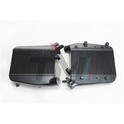
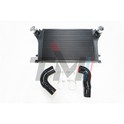
In the realm of automotive engineering, the pursuit of enhanced performance and efficiency is a constant endeavor. As a leading supplier of N20 intercoolers, I am often asked whether our N20 intercooler can be used in a hybrid vehicle. This question delves into the intersection of traditional internal combustion engine (ICE) technology and the burgeoning field of hybrid powertrains. In this blog post, I will explore the technical aspects of the N20 intercooler and evaluate its compatibility with hybrid vehicles.
Understanding the N20 Intercooler
Before we can determine the suitability of the N20 intercooler for hybrid vehicles, it is essential to understand its function and design. The N20 is a turbocharged inline - 4 engine produced by BMW. An intercooler is a crucial component in a turbocharged or supercharged engine system. Its primary function is to cool the compressed air that comes from the turbocharger or supercharger before it enters the engine's intake manifold.
When air is compressed by a turbocharger, its temperature rises significantly. Hot air is less dense than cold air, which means that for a given volume, hot air contains fewer oxygen molecules. Since the combustion process in an engine requires oxygen, less dense air can lead to a less efficient combustion and reduced power output. By cooling the compressed air, the intercooler increases its density, allowing more oxygen to enter the engine. This results in a more efficient combustion process, increased power, and improved fuel economy.
The N20 intercooler is designed specifically for the N20 engine, taking into account its unique characteristics such as the turbocharger's boost pressure, airflow rate, and the engine's intake requirements. It is engineered to provide optimal cooling performance within the operating parameters of the N20 engine.
Hybrid Vehicle Powertrains
Hybrid vehicles combine an internal combustion engine with an electric motor and a battery pack. There are different types of hybrid powertrains, including parallel hybrids, series hybrids, and plug - in hybrids.
In a parallel hybrid, both the ICE and the electric motor can directly drive the wheels. The electric motor can assist the ICE during acceleration or operate independently at low speeds. Series hybrids, on the other hand, use the ICE primarily to generate electricity, which is then used to power the electric motor that drives the wheels. Plug - in hybrids have larger battery packs that can be charged from an external power source, allowing for extended electric - only driving ranges.
The presence of an electric motor in a hybrid vehicle changes the operating conditions of the ICE compared to a conventional vehicle. The electric motor can take over some of the load, reducing the need for the ICE to operate at high power levels continuously. This can result in different boost requirements and airflow patterns for the turbocharged ICE in a hybrid vehicle.
Compatibility of the N20 Intercooler with Hybrid Vehicles
Airflow and Boost Requirements
One of the key factors to consider when evaluating the compatibility of the N20 intercooler with a hybrid vehicle is the airflow and boost requirements. In a hybrid vehicle, the ICE may not operate at full throttle as often as in a conventional vehicle. This means that the turbocharger may not generate as much boost, and the airflow through the intercooler may be lower.
The N20 intercooler is designed to handle the airflow and boost levels typical of the N20 engine in a non - hybrid application. If the airflow and boost in a hybrid vehicle are significantly lower, the intercooler may be oversized. An oversized intercooler can lead to increased pressure drop, which can reduce the efficiency of the intake system. However, if the hybrid vehicle is designed to use the ICE for high - performance driving scenarios, the N20 intercooler may still be able to handle the airflow and boost requirements.
Cooling Capacity
Another important aspect is the cooling capacity of the N20 intercooler. Hybrid vehicles often have different cooling requirements compared to conventional vehicles. The battery pack and the electric motor also generate heat, and the vehicle's cooling system needs to be designed to handle this additional heat load.
The N20 intercooler is sized and designed to cool the compressed air for the N20 engine in a non - hybrid environment. In a hybrid vehicle, the overall cooling system may need to be re - evaluated to ensure that the intercooler can still provide adequate cooling. If the cooling system is overwhelmed by the combined heat from the ICE, the battery pack, and the electric motor, the intercooler may not be able to cool the compressed air effectively, leading to reduced performance.


Integration with the Hybrid System
Integrating the N20 intercooler into a hybrid vehicle also requires careful consideration of the vehicle's control systems. Hybrid vehicles use sophisticated control algorithms to manage the operation of the ICE, the electric motor, and the battery pack. The intercooler needs to be integrated into these control systems to ensure that it operates in harmony with the rest of the powertrain.
For example, the control system may need to adjust the boost pressure of the turbocharger based on the state of charge of the battery and the power demand from the driver. The intercooler's performance can be affected by these changes in boost pressure, and the control system needs to be able to compensate for any variations.
Potential Benefits of Using the N20 Intercooler in a Hybrid Vehicle
Despite the challenges, there are potential benefits to using the N20 intercooler in a hybrid vehicle.
Performance Enhancement
If the hybrid vehicle is designed with a performance - oriented ICE, the N20 intercooler can help to improve the engine's power output. By cooling the compressed air, the intercooler can increase the density of the intake air, resulting in a more efficient combustion process. This can lead to improved acceleration and overall performance, especially during high - power driving situations.
Cost - Effectiveness
As a well - established component, the N20 intercooler may offer a cost - effective solution for hybrid vehicle manufacturers. Since it is already in production, there may be economies of scale that can reduce the cost of integration compared to developing a new intercooler specifically for a hybrid vehicle.
Related Products
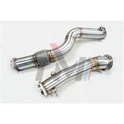
In addition to the N20 intercooler, we also offer other high - quality automotive components such as the N55 Downpipe, S58 Downpipe, and BMW S50 S52 Manifold. These products are designed to enhance the performance of BMW engines and can be used in a variety of applications, including hybrid vehicles.
Conclusion
The question of whether the N20 intercooler can be used in a hybrid vehicle is not a straightforward one. While there are challenges related to airflow, boost requirements, cooling capacity, and integration with the hybrid system, there are also potential benefits in terms of performance enhancement and cost - effectiveness.
Each hybrid vehicle is unique, and a thorough evaluation of the vehicle's powertrain characteristics, cooling requirements, and control systems is necessary to determine the suitability of the N20 intercooler. As a supplier of N20 intercoolers, we are committed to working with hybrid vehicle manufacturers to provide solutions that meet their specific needs.
If you are interested in exploring the possibility of using our N20 intercooler in your hybrid vehicle or have any questions about our products, we invite you to contact us for a detailed discussion. Our team of experts is ready to assist you in finding the best solution for your automotive application.
References
- Heywood, J. B. (1988). Internal Combustion Engine Fundamentals. McGraw - Hill.
- Chan, C. C. (2007). The State of the Art of Electric, Hybrid, and Fuel Cell Vehicles. Proceedings of the IEEE, 95(4), 704 - 718.