Does the MK7 R Intercooler Reduce Turbo Lag?
As a supplier of the MK7 R intercooler, I've received numerous inquiries about its ability to reduce turbo lag. Turbo lag is a common concern among car enthusiasts, especially those with turbocharged vehicles like the MK7 R. In this blog post, we'll delve into the science behind turbo lag, how an intercooler works, and whether the MK7 R intercooler can effectively mitigate this issue.
Understanding Turbo Lag
Turbo lag refers to the delay between pressing the accelerator pedal and the turbocharger providing a noticeable increase in power. This delay occurs because the turbocharger needs time to spool up, which means the exhaust gases need to build up enough pressure to spin the turbine and compressor wheels. During this spool - up period, the engine may not respond as quickly as desired, resulting in a lack of immediate power.
Several factors contribute to turbo lag, including the size of the turbocharger, the engine's displacement, and the exhaust system design. Larger turbochargers generally have more inertia, which means they take longer to spool up. On the other hand, smaller turbochargers may spool up more quickly but may not be able to provide as much boost at higher RPMs.
How an Intercooler Works
Before we discuss whether the MK7 R intercooler can reduce turbo lag, it's essential to understand how an intercooler functions. An intercooler is a heat exchanger that cools the compressed air coming from the turbocharger before it enters the engine. When air is compressed by the turbocharger, its temperature rises significantly. Hot air is less dense than cold air, which means there is less oxygen available for combustion. By cooling the compressed air, the intercooler increases its density, allowing more oxygen to enter the engine. This results in more efficient combustion and increased power output.
The cooling process in an intercooler typically involves passing the hot compressed air through a series of tubes or fins, which are exposed to ambient air. As the ambient air flows over the tubes or fins, it absorbs heat from the compressed air, cooling it down. Some intercoolers also use a liquid - cooling system for more efficient heat transfer.
Can the MK7 R Intercooler Reduce Turbo Lag?
Now, let's address the question at hand: does the MK7 R intercooler reduce turbo lag? The answer is not a straightforward yes or no. While an intercooler itself does not directly reduce the time it takes for the turbocharger to spool up, it can have an indirect impact on turbo lag.
One way the MK7 R intercooler can help is by improving the overall efficiency of the engine. When the compressed air is cooled by the intercooler, the engine can produce more power with the same amount of fuel. This means that the engine can respond more quickly to throttle inputs, reducing the perceived turbo lag. For example, if the engine is able to generate more power at lower RPMs due to the increased air density provided by the intercooler, it may feel like the turbocharger is spooling up faster.
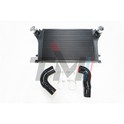
Another factor to consider is the design of the MK7 R intercooler. A well - designed intercooler can minimize the pressure drop across the intercooler. A high pressure drop can cause the turbocharger to work harder to maintain the desired boost pressure, which can increase turbo lag. The MK7 R intercooler is engineered to have a low pressure drop, allowing the turbocharger to operate more efficiently and potentially reducing turbo lag.
However, it's important to note that the MK7 R intercooler alone may not completely eliminate turbo lag. Other modifications, such as upgrading the turbocharger, optimizing the exhaust system, or tuning the engine management system, may be necessary to achieve significant reductions in turbo lag.
Complementary Products
In addition to the MK7 R intercooler, there are other products that can work in tandem to improve the performance of your vehicle and potentially reduce turbo lag. For instance, the Toyota 1JZGTE VVTI Manifold is designed to optimize the flow of exhaust gases, which can help the turbocharger spool up more quickly. Similarly, the Audi A5 Q5 A6 Manifold is engineered to enhance the exhaust flow in Audi vehicles, improving turbocharger response. And for those with an RS6 C8, the RS6 C8 Downpipes can significantly reduce backpressure in the exhaust system, allowing the turbocharger to operate more efficiently.
Contact for Procurement
If you're interested in purchasing the MK7 R intercooler or any of our other performance - enhancing products, we encourage you to reach out to us. Our team of experts is ready to assist you with your procurement needs and provide you with detailed information about our products. Whether you're a professional mechanic or a car enthusiast looking to upgrade your vehicle, we can offer the solutions you need to improve your car's performance.


References
- Bosch, R. (2007). Automotive Handbook. Robert Bosch GmbH.
- Heywood, J. B. (1988). Internal Combustion Engine Fundamentals. McGraw - Hill.
- Crolla, D. A. (2001). The Automotive Chassis: Engineering Principles. Society of Automotive Engineers.