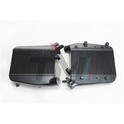
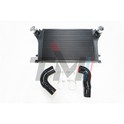
Yo, what's up guys! I'm an N20 intercooler supplier, and today I wanna talk about how the N20 intercooler affects the turbo lag in a turbo - charged N20 engine.
First off, let's get a basic understanding of what turbo lag is. Turbo lag is that annoying delay between when you step on the gas pedal and when the turbocharger actually kicks in and provides that extra power boost. It's like waiting for a slacker to finally get to work. You press the pedal, and there's this momentary pause before the engine really starts to go.
Now, the N20 engine is a pretty popular turbo - charged engine, especially in some BMW models. It's known for its decent power output and efficiency. But like any turbo - charged engine, it suffers from turbo lag. That's where our N20 intercooler comes in.
So, how does an intercooler work? Well, when the turbocharger compresses the air going into the engine, it heats it up. Hot air is less dense than cold air, which means there are fewer oxygen molecules in a given volume of hot air. And since the engine needs oxygen to burn fuel and make power, having hot air isn't ideal. An intercooler cools down this compressed air before it enters the engine. Cooler air is denser, so there are more oxygen molecules available for combustion, which can lead to more power.
But how does this relate to turbo lag? When the air is cooler and denser, the engine can make power more efficiently. This means that the turbocharger doesn't have to work as hard to achieve the same level of performance. And when the turbocharger doesn't have to work as hard, it can spool up faster. Spooling up is the process of the turbocharger getting up to speed and starting to provide boost. So, by using an N20 intercooler, we can reduce the time it takes for the turbocharger to spool up, which in turn reduces turbo lag.
Let's dig a little deeper into the science behind it. The turbocharger is driven by the exhaust gases from the engine. When you step on the gas pedal, the engine starts to produce more exhaust gases, which spin the turbine of the turbocharger. But if the air going into the engine is hot and less dense, the engine doesn't produce as much power, and there aren't as many exhaust gases to spin the turbine quickly. With an intercooler cooling the air, the engine makes more power, more exhaust gases are produced, and the turbine spins up faster.
Another factor is the pressure ratio. The turbocharger increases the pressure of the air going into the engine. But if the air is too hot, the pressure can build up unevenly, and the turbocharger might not work as efficiently. The intercooler helps to stabilize the pressure by cooling the air. This more stable pressure allows the turbocharger to operate more smoothly and spool up faster, reducing turbo lag.
Now, I know some of you might be thinking, "Is it really that big of a difference?" Well, I've seen it firsthand. Customers who have installed our N20 intercoolers have reported a noticeable reduction in turbo lag. They say that the engine responds quicker when they step on the gas, and the power delivery is more linear. It's like night and day compared to driving without an intercooler.
And it's not just about reducing turbo lag. Using an N20 intercooler can also increase the overall power and efficiency of the engine. Since the engine can burn fuel more efficiently with denser air, you might even see an improvement in fuel economy. It's a win - win situation.
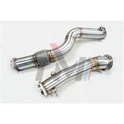
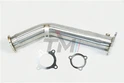
If you're looking to upgrade your N20 engine, you might also be interested in other components. For example, a N20 Downpipe can further improve the performance of your turbo - charged engine. A downpipe allows the exhaust gases to flow more freely out of the engine, which can help the turbocharger spool up even faster. And if you're into Mercedes - Benz AMG E63 W212 2Matic, check out the AMG E63 W212 2Matic Downpipes. They're designed to optimize the exhaust flow for that specific model. And for BMW F80 M3 owners, the F80 M3 Midpipe can be a great addition to enhance the performance.
In conclusion, the N20 intercooler plays a crucial role in reducing turbo lag in a turbo - charged N20 engine. By cooling the compressed air, it allows the engine to make more power, stabilizes the pressure, and helps the turbocharger spool up faster. If you're tired of that annoying turbo lag and want to get the most out of your N20 engine, our N20 intercooler is definitely worth considering.
If you're interested in purchasing our N20 intercoolers or have any questions about how they can improve your engine's performance, don't hesitate to reach out. We're here to help you take your driving experience to the next level.


References
- Heywood, J. B. (1988). Internal Combustion Engine Fundamentals. McGraw - Hill.
- Crolla, D. A. (2001). The Automotive Chassis: Engineering Principles. Society of Automotive Engineers.