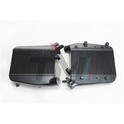
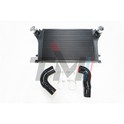
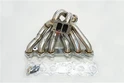
Yo, what's up everyone! I'm an intercooler supplier, and today I wanna dig into a pretty interesting question: Can an intercooler be used in a natural - aspiration engine for any benefits?
First off, let's quickly cover what an intercooler is. An intercooler is basically a heat exchanger. Its main job is to cool down the air that's going into the engine. In turbocharged or supercharged engines, it's a no - brainer. When you compress air with a turbo or a supercharger, the air gets hot. Hot air is less dense, which means there are fewer oxygen molecules per unit volume. And since an engine needs oxygen to burn fuel, less dense air means less power. An intercooler cools that compressed air, making it denser and allowing the engine to make more power.
But what about natural - aspiration engines? These engines don't have a turbo or a supercharger forcing air in. They rely on the vacuum created by the pistons moving down in the cylinders to suck air in. So, at first glance, it might seem like an intercooler wouldn't have much of a role here.
The Potential Benefits
1. Air Density and Combustion
Even in a natural - aspiration engine, the air that enters the engine can heat up. This can happen due to various reasons. For example, the air passing through the intake manifold can pick up heat from the engine block. Also, on hot days, the ambient air itself is warmer. Warmer air is less dense, just like in a forced - induction engine.
When you use an intercooler in a natural - aspiration engine, it can cool down this incoming air. Cooler, denser air means more oxygen molecules are available for combustion. With more oxygen, the fuel can burn more efficiently. This can lead to a more complete combustion process, which in turn can result in a slight increase in power output. It's not going to turn your naturally - aspirated engine into a high - performance beast overnight, but it can give you a little extra oomph.
2. Engine Efficiency
A more efficient combustion process also means better fuel economy. When the fuel burns more completely, you're getting more energy out of each drop of fuel. This can save you some money at the gas pump in the long run.
Another aspect of engine efficiency is related to engine knocking. Engine knocking occurs when the air - fuel mixture in the cylinders ignites prematurely. This can be caused by high temperatures. By cooling the incoming air with an intercooler, you can reduce the chances of engine knocking. This allows the engine to run more smoothly and can also prevent potential damage to the engine over time.
3. Throttle Response
Cooler air is more responsive to changes in throttle input. In a natural - aspiration engine, when you step on the gas pedal, the engine needs to quickly adjust the air - fuel mixture. With cooler, denser air, the engine can react more quickly. This can improve the overall throttle response, making the car feel more lively and engaging to drive.
The Challenges
1. Cost - Benefit Analysis
Adding an intercooler to a natural - aspiration engine comes with a cost. You have to buy the intercooler itself, and there are also installation costs. You might need to modify the intake system to fit the intercooler properly. And then there's the maintenance. Intercoolers need to be kept clean to work effectively. So, you have to weigh these costs against the relatively small benefits you're likely to get.
2. Space Constraints
Natural - aspiration engines often don't have a lot of extra space in the engine bay. Fitting an intercooler can be a challenge. You need to find a spot where it can get enough airflow to cool the air effectively, but at the same time, it shouldn't interfere with other engine components.


Real - World Examples and Applications
Some car enthusiasts have experimented with adding intercoolers to their naturally - aspirated engines. For example, in the world of motorsports, where every little bit of performance gain matters, some racers have installed intercoolers on their naturally - aspirated race cars.
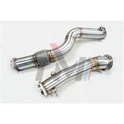
Let's say you're into modifying your car for better performance. If you have a BMW with a B58 engine, you might be interested in B58 Downpipe. A downpipe can improve exhaust flow, and when combined with an intercooler, it can enhance the overall performance of your naturally - aspirated or even turbocharged engine.
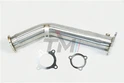
For those with a G82 M4, a G82 M4 Midpipe can also play a role in optimizing the exhaust system. And if you own an R35 GTR, R35 GTR Heat Shield Catted Downpipes can be a great addition to your performance - enhancing setup.
Conclusion
So, can an intercooler be used in a natural - aspiration engine for any benefits? The answer is yes. There are potential benefits in terms of power, fuel economy, engine efficiency, and throttle response. However, it's not a one - size - fits - all solution. You need to consider the cost, space constraints, and whether the benefits are worth the investment for your specific situation.
If you're thinking about adding an intercooler to your natural - aspiration engine or have any questions about intercoolers in general, I'm here to help. I've got a wide range of intercoolers that can suit different engine types and setups. Reach out to me, and we can have a chat about how an intercooler can work for you. Let's make your engine perform at its best!
References
- Heywood, J. B. (1988). Internal Combustion Engine Fundamentals. McGraw - Hill.
- Crolla, D. A. (2001). The Automotive Chassis: Engineering Principles. Society of Automotive Engineers.