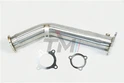
When it comes to exhaust tailpipes, the choice of material can significantly influence various aspects of a vehicle's performance and characteristics, including vibration. As a trusted titanium tailpipe supplier, I've witnessed firsthand the unique properties of titanium and how they compare to other materials in terms of vibration. In this blog, we'll delve into the science behind vibration in tailpipes and explore how titanium stacks up against other common materials.
Understanding Vibration in Tailpipes
Vibration in exhaust tailpipes is a complex phenomenon influenced by multiple factors. At its core, vibration is generated by the flow of exhaust gases through the pipe. The high - velocity and pulsating nature of the exhaust flow creates pressure fluctuations that can cause the tailpipe to vibrate. Additionally, the engine's operation, including its firing order and RPM, also contributes to the vibration characteristics of the tailpipe.
The frequency and amplitude of the vibration are crucial factors. High - frequency vibrations can lead to rapid wear and tear, while large - amplitude vibrations may cause noise and discomfort for the vehicle occupants. Moreover, excessive vibration can also affect the structural integrity of the tailpipe over time.
Vibration in Titanium Tailpipes
Titanium is a remarkable material known for its high strength - to - weight ratio, corrosion resistance, and excellent heat resistance. When it comes to vibration, titanium's unique properties play a significant role.
Firstly, titanium has a relatively low density compared to many other metals used in tailpipe construction, such as steel. This low density means that the mass of the titanium tailpipe is reduced. According to the laws of physics, a lower - mass object is less likely to resonate at certain frequencies. In other words, titanium tailpipes are less prone to being excited by the exhaust gas flow and engine vibrations, resulting in lower overall vibration levels.
Secondly, titanium has good damping properties. Damping is the ability of a material to dissipate energy when it vibrates. When the exhaust gases cause the titanium tailpipe to vibrate, the material can absorb and convert the vibrational energy into heat, which is then dissipated. This helps to reduce the amplitude of the vibration and prevent it from building up to high levels.
In real - world applications, vehicles equipped with titanium tailpipes often experience smoother operation. The reduced vibration not only improves the driving experience but also extends the lifespan of the tailpipe and other connected components. For example, in high - performance sports cars, where engine power and exhaust gas flow are substantial, a titanium tailpipe can effectively manage the vibration, ensuring reliable performance over time.
Comparison with Stainless Steel Tailpipes
Stainless steel is another popular material for exhaust tailpipes. Stainless Steel Exhaust Tail Pipe is widely used due to its affordability, durability, and corrosion resistance. However, when it comes to vibration, there are some notable differences compared to titanium.
Stainless steel has a higher density than titanium. This means that a stainless - steel tailpipe has more mass, which can make it more likely to resonate at certain frequencies. As a result, stainless - steel tailpipes may experience higher vibration levels, especially at specific engine RPMs where the natural frequency of the tailpipe matches the excitation frequency from the exhaust gas flow or engine.
In addition, stainless steel generally has lower damping properties compared to titanium. When the stainless - steel tailpipe vibrates, it is less efficient at dissipating the vibrational energy. This can lead to larger - amplitude vibrations and potentially more noise. Over time, the higher vibration levels can also cause more stress on the stainless - steel tailpipe, increasing the risk of fatigue failure.
Comparison with Other Exotic Materials
There are also other exotic materials used in high - end exhaust systems, such as carbon fiber composites. While carbon fiber has an extremely low density and high strength, its vibration characteristics are different from titanium.
Carbon fiber composites are very stiff, which means they can transmit vibrations more easily. Unlike titanium, which can dampen vibrations, carbon fiber may allow the vibrations to travel through the material with less attenuation. This can result in a more direct transfer of the exhaust and engine vibrations to the vehicle body, potentially causing more noise and discomfort.
On the other hand, carbon fiber tailpipes are often used in combination with other materials or have special designs to manage vibration. However, these additional measures add to the complexity and cost of the exhaust system.
Real - World Examples
Let's take a look at some real - world examples to illustrate the differences in vibration between titanium and other materials.
In the high - performance automotive industry, many manufacturers are turning to titanium for their exhaust systems. The TAIMEI Exhaust System BMW S63 X5m F85 CATBACK With Muffler And Valve features a titanium tailpipe. Customers who have installed this system have reported a significant reduction in vibration compared to the stock stainless - steel exhaust. The smooth operation of the vehicle is enhanced, and the overall noise level is also reduced.
Another example is the Lamborghini Huracan EVO Performante X - Pipe Ti Exhaust System. Lamborghini, known for its high - performance supercars, has chosen titanium for its exhaust system to optimize performance and reduce vibration. The titanium tailpipe ensures that the powerful engine's exhaust gases are managed efficiently, with minimal vibration and noise.
Conclusion and Call to Action
In conclusion, titanium tailpipes offer significant advantages in terms of vibration compared to other materials. Their low density and excellent damping properties result in lower vibration levels, which in turn improve the driving experience, reduce noise, and extend the lifespan of the tailpipe and related components.


If you're in the market for a high - quality tailpipe that can effectively manage vibration, I encourage you to consider our titanium tailpipes. As a leading supplier, we offer a wide range of titanium tailpipes suitable for various vehicle models and applications. Whether you're a car enthusiast looking to upgrade your vehicle's exhaust system or an automotive manufacturer seeking reliable components, we have the expertise and products to meet your needs. Contact us today to start a discussion about your specific requirements and explore how our titanium tailpipes can enhance your vehicle's performance.
References
- "Materials Science and Engineering: An Introduction" by William D. Callister Jr. and David G. Rethwisch
- "Automotive Exhaust Systems: Design, Engineering, and Performance" by Crolla, D. A.
- Research papers on the mechanical properties of titanium and its applications in automotive engineering.