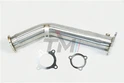
Hey there, fellow car enthusiasts! I'm a supplier of Golf 8 downpipes, and today, I wanna dive deep into a topic that's crucial for optimizing the performance of your Golf 8: the optimal exhaust backpressure with a downpipe.
First off, let's talk about what exhaust backpressure is. In simple terms, it's the resistance that the exhaust gases face as they flow out of the engine through the exhaust system. You might think that less backpressure is always better, but it's not that straightforward. A certain amount of backpressure is actually necessary for the engine to function properly.
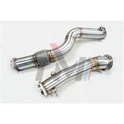
When you install a downpipe on your Golf 8, you're essentially modifying the exhaust system to allow for better flow of exhaust gases. A downpipe replaces the factory catalytic converter and the exhaust pipe that connects the turbocharger to the rest of the exhaust system. This modification can significantly improve the engine's performance, but it also affects the backpressure.
So, what's the optimal exhaust backpressure for a Golf 8 with a downpipe? Well, it depends on several factors, including the engine's design, the turbocharger's characteristics, and your driving style. Generally speaking, a lower backpressure is better for high - performance driving, as it allows the engine to expel exhaust gases more quickly, which in turn can increase horsepower and torque. However, if the backpressure is too low, it can cause some issues.
One of the main problems with extremely low backpressure is that it can lead to a loss of low - end torque. The engine needs a certain amount of backpressure to help scavenge the exhaust gases from the cylinders and to maintain proper airflow through the intake system. Without enough backpressure, the engine may struggle to produce power at lower RPMs, making it feel sluggish in stop - and - go traffic or during low - speed acceleration.
On the other hand, if the backpressure is too high, it can restrict the flow of exhaust gases, causing the engine to work harder and reducing its efficiency. This can lead to a decrease in horsepower and an increase in fuel consumption. It can also put more stress on the turbocharger, potentially shortening its lifespan.
For a Golf 8 with a downpipe, a good rule of thumb is to aim for a backpressure that is slightly lower than the factory setting but not too extreme. A backpressure of around 1 - 2 psi (pounds per square inch) at idle and 3 - 5 psi at wide - open throttle is often considered optimal. This range allows for a good balance between high - end performance and low - end torque.
To measure the exhaust backpressure, you'll need a backpressure gauge. This is a relatively inexpensive tool that can be installed in the exhaust system to monitor the pressure. You can find backpressure gauges at most auto parts stores or online. Once you've installed the gauge, you can start adjusting the exhaust system to achieve the optimal backpressure.
If you find that the backpressure is too high, you can try modifying the exhaust system further. This could involve installing a larger diameter downpipe or a high - flow catalytic converter. On the other hand, if the backpressure is too low, you might need to add some restrictions to the exhaust system, such as a resonator or a muffler with a more restrictive design.
Now, let's talk about some of the benefits of getting the optimal exhaust backpressure for your Golf 8 with a downpipe. First of all, you'll notice an improvement in the engine's overall performance. The engine will be more responsive, and you'll experience an increase in horsepower and torque. This means faster acceleration and better top - end speed.
Secondly, a properly tuned exhaust backpressure can also improve fuel efficiency. When the engine can expel exhaust gases more efficiently, it doesn't have to work as hard, which can lead to better fuel economy. This is especially important if you use your Golf 8 as a daily driver.
Another benefit is that it can enhance the sound of your Golf 8. A well - designed exhaust system with the right backpressure can produce a deep, throaty growl that adds to the overall driving experience. It gives your car a more aggressive and sporty sound without being overly loud or annoying.
If you're looking for other performance - enhancing parts for your car, I'd like to mention some related products. You can check out the Car Charge Pipe and the Mk7 Gti Charge Pipe which can further improve the airflow and performance of your engine. And for those of you with a more exotic taste, the Lamborghini Huracan LP610 - 4 (2014 - 2019) Valvetronic Exhaust System is a great option to upgrade your supercar's exhaust.
As a Golf 8 downpipe supplier, I've seen firsthand how a well - installed downpipe can transform the performance of a Golf 8. But it's not just about slapping on a downpipe and calling it a day. You need to pay attention to the backpressure to get the most out of your modification.
If you're interested in purchasing a downpipe for your Golf 8 or have any questions about exhaust backpressure, feel free to reach out. I'm here to help you make the best decision for your car. Whether you're a casual driver looking for a bit more power or a hardcore performance enthusiast, I can provide you with the right downpipe and advice to optimize your Golf 8's performance.
In conclusion, finding the optimal exhaust backpressure for a Golf 8 with a downpipe is a balancing act. It requires some experimentation and tuning, but the rewards are well worth it. By getting the backpressure just right, you can unlock the full potential of your Golf 8's engine and enjoy a more exciting driving experience. So, don't be afraid to get your hands dirty and start fine - tuning your exhaust system.


References:
- "Automotive Engine Performance" by James D. Halderman
- Various automotive forums and enthusiast websites for real - world experiences and discussions on Golf 8 performance modifications.